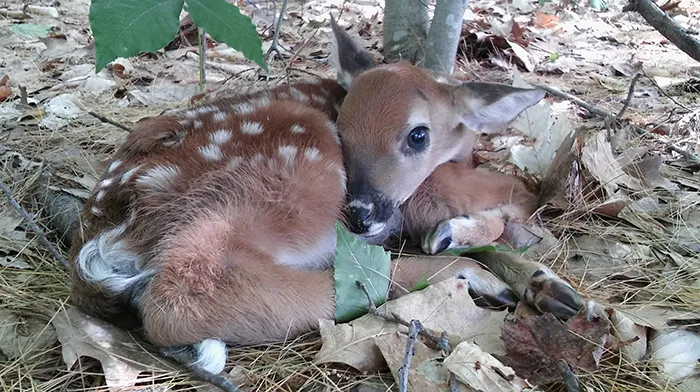
In the coming weeks, deer will begin giving birth around the Granite State, with the majority of deer fawns born in May and June. Each spring, many New Hampshire residents see young deer by themselves and fear the worst. Has the mother died? Has she abandoned her fawn? The answer in most cases is no. The doe is usually not far off, waiting to return to feed her newborn.
Adult deer can be easily detected by predators due to their scent and large size. For these reasons does will spend extended periods away from their fawns to disassociate their scent from the fawn, helping to keep them safe from predators. For the first month of life, the doe will only visit the fawn a few times a day to nurse quickly before leaving again, although usually not going too far away.
Some well-intentioned people who see fawns alone, however, assume that they have been abandoned and may take them in to try to help. Most of the time this act removes the fawn from the care it needs. The best chance a young wild animal has to survive is in its natural environment under the care of its mother. If you care, leave them there.
If you suspect a fawn or other young wildlife has been abandoned or orphaned, do not move the animal. Contact the New Hampshire Fish and Game Department by emailing wildlife@wildlife.nh.gov or calling (603) 271-2461 to initiate a report. Department staff can assess the situation and help determine the best course of action. In most instances, it is advisable to leave the fawn or other animal alone and allow time for the mother to return.
Do not approach, pet, or feed wildlife, and never remove any animal from its habitat. Only qualified people with special rehabilitator permits, issued through the New Hampshire Fish and Game Department, may take in and care for injured or orphaned wildlife. Improper care of injured or orphaned wildlife frequently leads to sickness or death and often the animals cannot be returned to the wild. For example, deer fawns that have been fed the wrong type of milk or formula will develop severe diarrhea (scours). For a full list of licensed wildlife rehabilitators, visit https://www.wildlife.nh.gov/wildlife-and-habitat/rehabilitators.
Please remember, the best way to help young wildlife is by keeping them wild. For more information, visit https://www.wildlife.nh.gov/wildlife-and-habitat/white-tailed-deer-new-hampshire.