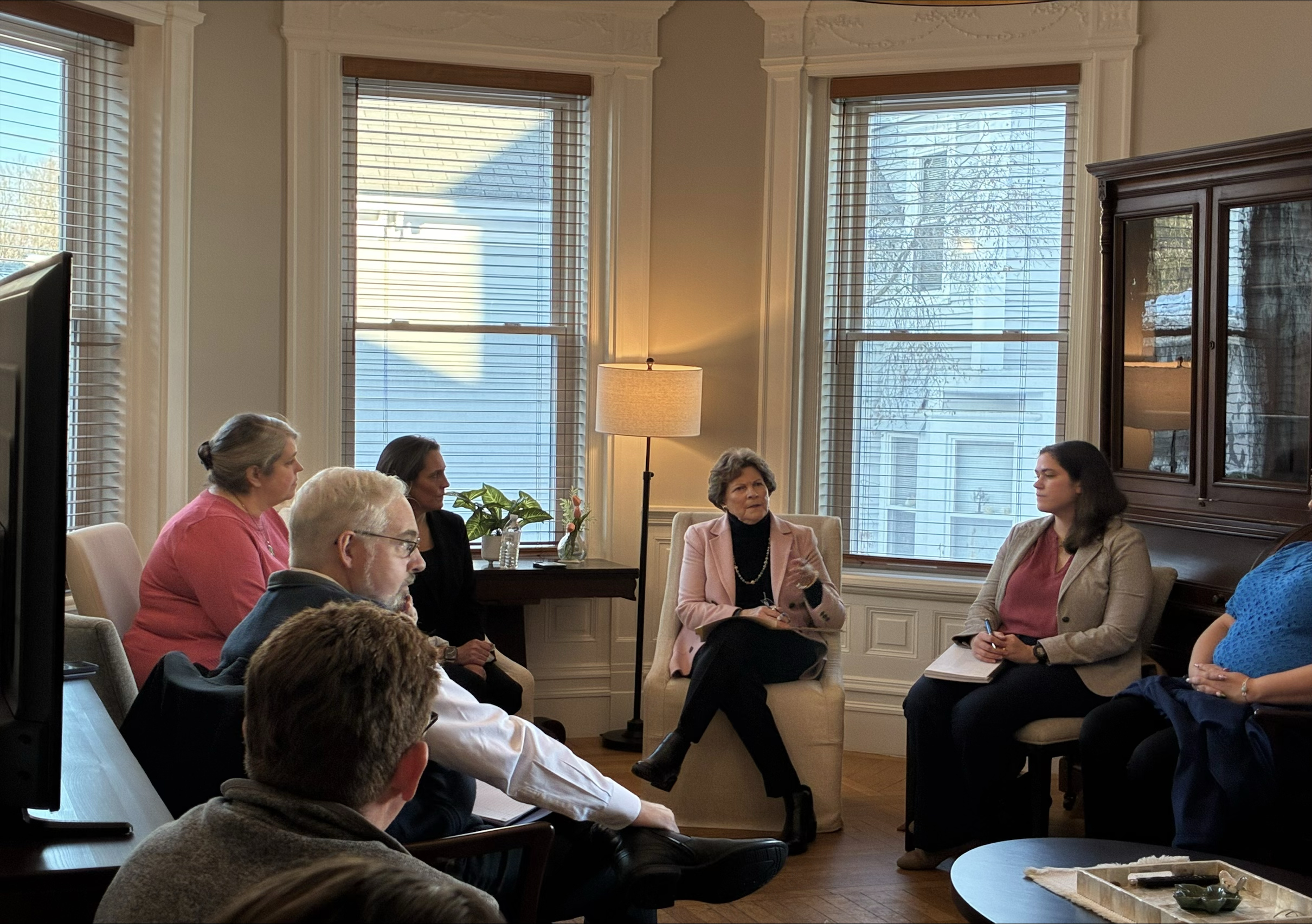
On Friday, January 9, U.S. Senator Jeanne Shaheen visited the Gafney Home in Rochester alongside local leaders, energy partners and community advocates to discuss the critical role of federally funded energy assistance and weatherization programs serving Strafford County residents.
The visit highlighted programs administered by the Community Action Partnership of Strafford County (CAPSC), including the Low-Income Home Energy Assistance Program (LIHEAP) and the Weatherization Assistance Program (WAP), which help families manage rising heating costs and improve long-term energy efficiency.
Senator Shaheen called the Gafney Home renovation, which concluded in 2024, “an exciting project” and emphasized her long-standing commitment to energy efficiency.
“Those of you who know my history know that I’ve spent a lot of time over the years talking about the importance of energy efficiency and the energy challenges that we face as a state,” Senator Shaheen said.
The discussion focused on recent federal and state policy changes which have made certain proto complete comprehensive energy efficiency upgrades—particularly for historic buildings like the Gafney Home.
Chase Pennoyer, President of Resilient Buildings Group (RBG), who worked closely with CAPSC on the Gafney Home project, explained the importance of partnership and flexible funding.
Bob Arnold, Director of Housing Development and Revitalization at CAPSC, raised concerns about funding caps and regulatory constraints.
“Our biggest issue is the potential loss of federal funding, as well as decisions being made locally in New Hampshire,” Arnold said, explaining that rising material and labor costs have outpaced newly established project limits of $15,000 per weatherization project, set by the Public Utilities Commission (PUC).
“Ten years ago, the average weatherization project cost about $7,500. The cost is more than double that now. Today, we’re seeing $20,000 to $25,000 to do the job right- to offer a full package,” Arnold said. “So there lies the problem for us. But fortunately, we have other funding sources that we can braid in and make projects more complete.”
Pennoyer added that state mandated cost-effectiveness tests often fail to capture the full benefits of energy efficiency, by failing to focus on environmental benefits, which can make projects harder to “pencil out” when put to the test of the Granite State Cost Test.
“If I could sort of have one request to regulators, it would be working to find ways to help cost-effectiveness of projects become more achievable,” Pennoyer added.
The focus of the discussion then shifted to the growing demand for fuel assistance this winter. CAPSC Fuel and Electric Assistance Program Manager Melena Lugo reported a sharp increase in applications.
“Last year we helped nearly 2,600 people, and this year we’re already at more than 2,100—even though the program only opened last month,” Lugo said.
In addition to an increased need for Fuel and Electrical Assistance benefits across the county, Lugo expressed concern about reduced benefits for many households.
“We’re getting calls every day from people who used to receive $1,200 in past years, and are now only receiving $500,” Lugo said. “Unfortunately, it just is what it is. That is all she’s going to get from that program this year.”
Jamie Swan, CAPSC Chief Program Officer, described the real-life impacts of those cuts.
“We still have families keeping their heat set at 60 degrees, because they are just trying to make their benefits last” Swan said. “Our families are living paycheck to paycheck, so no matter how much case management or budgeting we can do, they are still struggling.”
“Here, we’re fortunate that we have the Gift of Warmth and in Strafford County; The donations are phenomenal, and the community really rallies around bringing that money in, so we are able to supplement people’s fuel bills. It doesn’t cover the whole cost, but it can help,” Swan said, “But there are communities that aren’t as fortunate and that can’t do that throughout the state, and so it’s great that we can do that here. But in New Hampshire as a whole, there are towns that are struggling.”
Swan also warned that limits on weatherization funding can have severe housing consequences, noting that without proper weatherization packages, homes can face several threats including frozen pipes or broken boilers- both of which could cause a home to become unlivable.
Senator Shaheen expressed concern over delays in federal funding and pledged to follow up.
“I had hoped we would see more funding,” Senator Shaheen said, noting that ongoing federal budget negotiations may “bring some relief” for the state.
More information about these programs can be found at straffordcap.org.