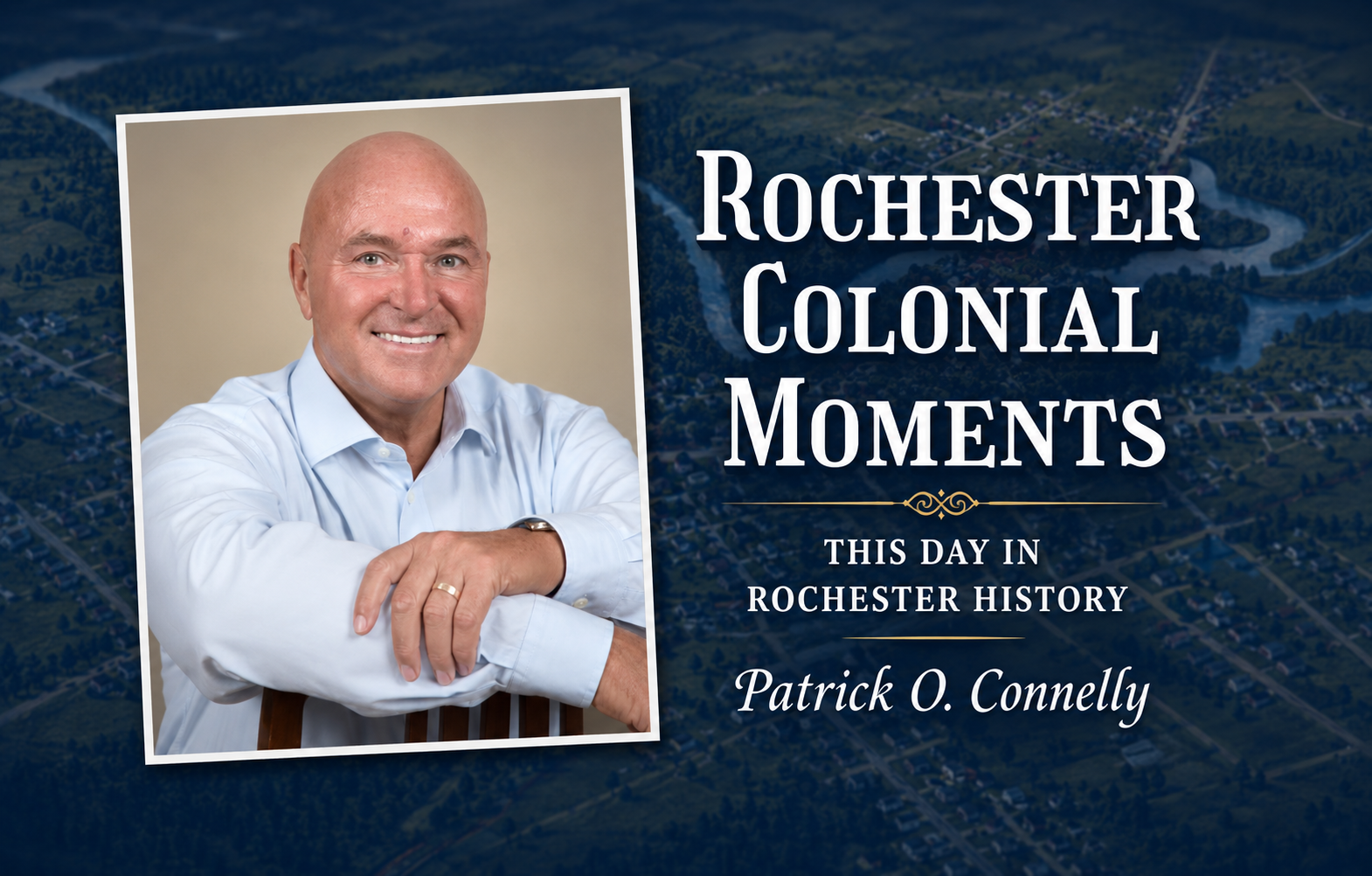
In celebration of the 250th Anniversary of the Signing of the Declaration of Independence, and in collaboration with the Office of Mayor Chuck Grassie, Rochester Colonial Moments, a historical series highlighting notable moments from Rochester’s past, is brought to you by Patrick O. Connelly, Rochester, New Hampshire, historian.
Monday, July 27, 2026
“By 1770, inhabitants of the town had begun to feel the strain of the distance from their farms to the meeting house. At that time, the meeting house stood where the town common and bandstand reside today. At the town meeting held on May 29, 1780, Moderator Squire John Plummer guided the town to agree that:
-
- The First Parish (main) would contain one-third of the town’s acreage (21,000 acres);
- Inhabitants residing above that line would be exempt from funding the building of the new meeting house; and
- An exemption from support of Rev. Joseph Haven was not acted upon at this meeting.
The task took approximately three years to complete, at a cost of £11,184, and extensive records outline the detailed costs of all aspects of the construction. Pew floor and gallery locations were auctioned at public venues to partly defray the cost of construction. Records of the project reflect the economic and social structure of the town during this period of history.”
Patrick O. Connelly is a historian, researcher, and author whose work focuses extensively on the colonial history and development of Rochester, New Hampshire. A graduate of the University of Texas at Austin with degrees in History and French, Connelly has spent decades researching Rochester’s earliest records, maps, land divisions, and settlement history.
Connelly is the author of two comprehensive works on Rochester’s colonial history: Rochester, New Hampshire: Territory to Township, 1620–1799 and In Their Own Words: Transcription and Research of the Original Records of Colonial Rochester, New Hampshire, 1722–1799. Both books are available through his website at RNHCC.com.