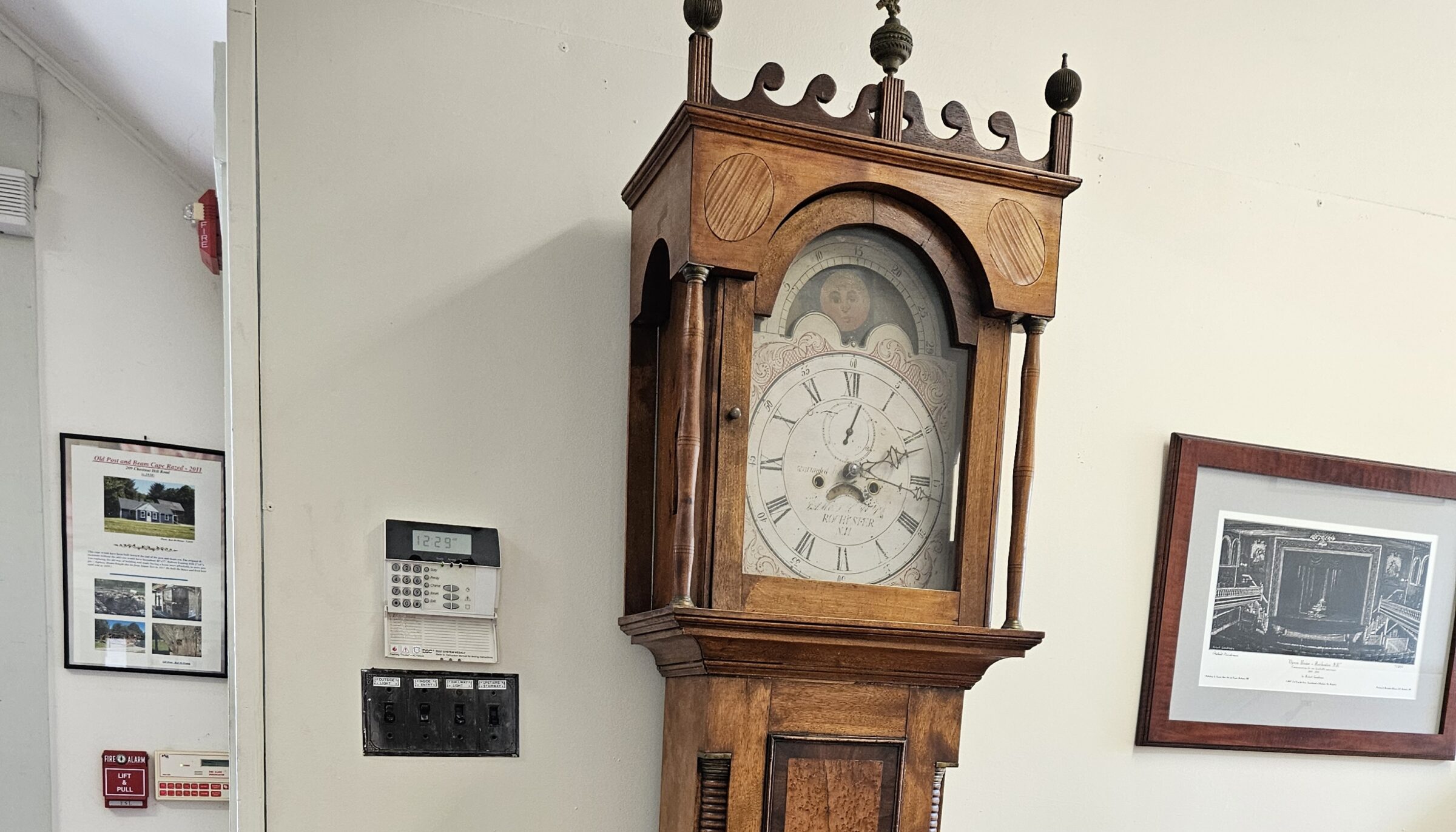
A message from the Rochester Historical Society and Museum:
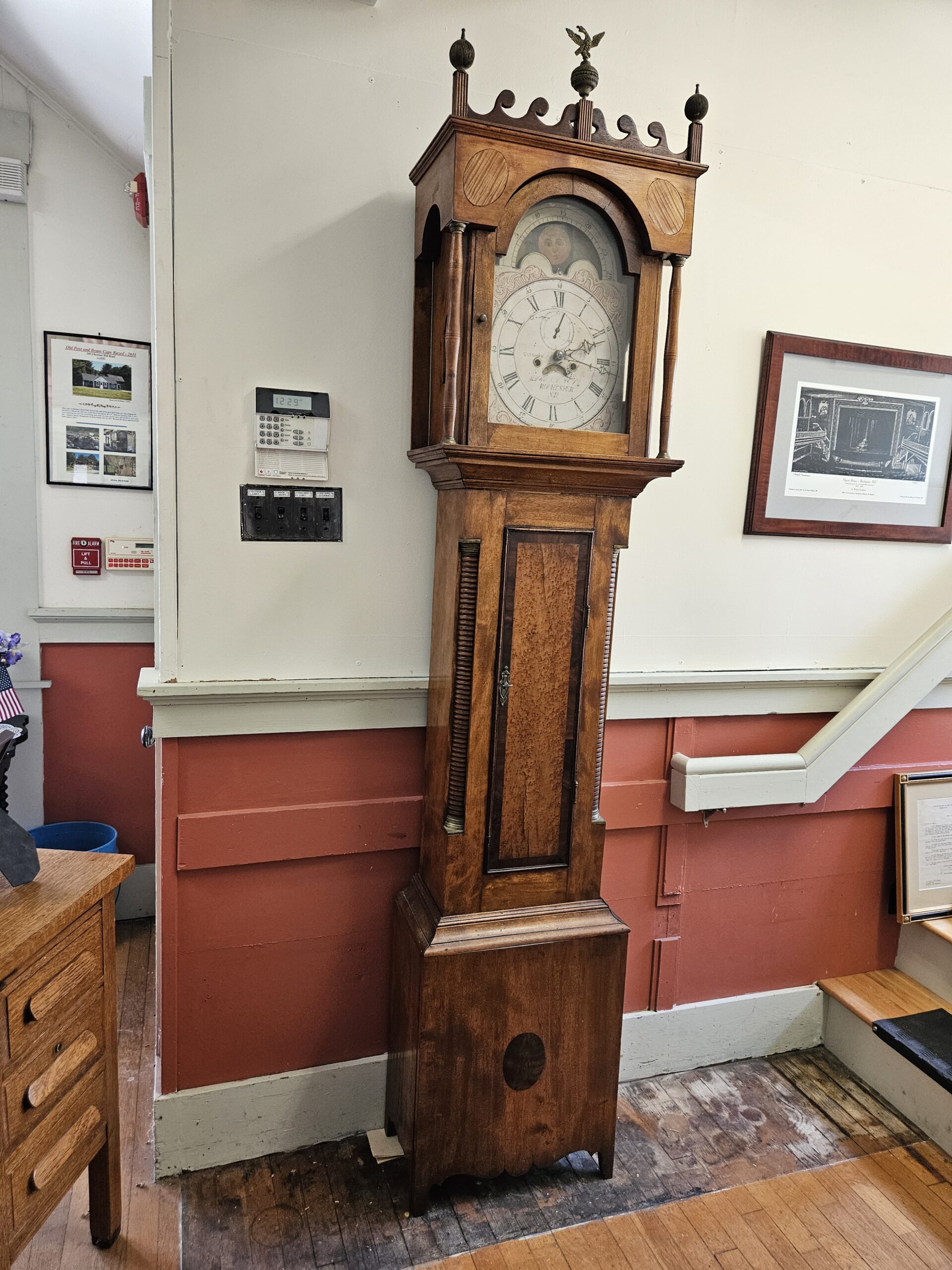
The object you are looking at in the photograph is approximately two hundred years old and was crafted by a young man from Rochester, N.H., whose name was James Charles Cole.
James Cole was born in Boston in 1791 and subsequently relocated to Rochester, New Hampshire, where he apprenticed under Edward Moulton, a jeweler and silversmith. Mr. Moulton eventually moved to Saco, Maine, and after about 1813, his business was carried on independently by young James Cole, who would have been in his early twenties. Mr. Cole’s business flourished, and he became known for his excellent craftsmanship, which included tall clocks and clocks of other styles as well. He also did silversmithing and created jewelry.
His clocks were made under his supervision by the skilled people whom he employed. The brass works for these clocks were created on site and mirrored the types made in England and Europe, which were noted for their accuracy. The cabinetry for Mr. Cole’s clocks was likely initially done by his friend Charles Dennett, a very well-known man at that time whose work with wood became legendary. It is possible that Mr. Dennett’s hand was involved in the example we are looking at. Detailed records of the craftsmen, unfortunately, have been lost to time. The results remain—works of precision, excellence, and significant beauty.
Mr. Cole’s clocks were sold in neighboring towns for $20.00, according to one source. In order to promote their sale, homeowners were allowed to buy the clock on “time,” so to speak. They were told to keep the clock for one month, after which payment would be collected. When the month was up and collectors expected to receive payment or take back the clock, customers often offered livestock or produce to satisfy the debt. They wanted to keep the clock.
Mr. Cole’s clocks became known as beautiful and reliable. In my research, I found a photograph that was discovered inside one of the clocks that passed through the hands of The Delaney Antiques Company. The photograph is reproduced and will hang beside this clock. It is a photograph of Mr. and Mrs. Cole. Comparing it to photographs from the period, it likely dates to the 1840s or 1850s.
Time. Today, we look at our smartphones and see a digital reading that urges us to either relax or hurry up. Have you heard the expression, “Got the time?” Or: “…just can’t find the time.” How about, “Time to go.” We measure our lives by an elusive, immaterial phenomenon that, mysteriously, has always been with us. Another famous expression comes to mind: “Time immemorial.”
We people who volunteer our time to historical societies like to think we’re “capturing” a bit of time, but of course we can’t actually do that. The paradoxical thing about time is that it’s both everything and nothing at the same time. It’s a sum total of man’s activities, comprised of infinitesimal individual efforts. It is an abstraction involving careful, reflective thinking.
Some men, like James Cole, make careful use of this elusive, mysterious element that exists in our lives. Some people write poems about it or songs; lamentably, some spend time harming other people or even destroying what is intrinsically valuable and good. The great English storyteller W. Somerset Maugham wrote that the real tragedy of man is that he has lost his ability to love.
Mr. Cole spent his hours and days crafting beautiful objects. This clock he made once stood in the home of a likely person in our city. The name of that person has become lost to time. A man in Wonalancet, New Hampshire, ultimately owned the clock. It was obtained by his father many years ago. He and his family noticed the words “Rochester, NH” on the dial and contacted me. I drove to get it. My round trip to Wonalancet was a little over three hours. The round trip involving Mr. Cole’s clock was perhaps a century or so, and possibly even longer.
The record of provenance has been lost. We don’t know who owned it or when. But we do know that it is now back home in Rochester. It ticks and chimes as a gentle reminder that what it measures is always escaping our grasp and moving relentlessly in one direction only.
The Rochester Historical Society is deeply grateful to Mr. Doug McVicar for donating this fine example of craftsmanship to our museum. His father was a clock collector and enthusiast.
The clock Mr. Cole created ticked and tocked away the time during this country’s early years of stagecoach travel, canals, and corduroy roads. Then came the blood-filled tragedy of the Civil War, followed by electricity, widespread railroad travel, the birth of flight, World War I, World War II, and the first manned space flights.
It now rests quietly here at our museum in temporary silence while it waits for what “time” and funding might come about to restore it to full working condition. Whether that comes about, though, is immaterial. Man often confuses his understanding of the objects he creates and acts as though the object is in control, not he. The truth is that men are in charge of the elusive thing we call “time” in the ways they use it, and they always have been. When a clock stops, time does not. Man makes instruments and creates measurements to guide his actions and activities. Some make wise use of this useful information. Some do not.
As we reflect upon this recent acquisition, we are reminded of some words of wisdom by Franklin McDuffee, the very fine historian whose book remains a main guidepost and source of information about the history of our city. The words he wrote on page 144 of his book appear as follows:
SOME WORDS OF WISDOM
“If we are candid and thoughtful, we cannot review the lives of the generations gone before us without being more strongly impressed with the sense of our own duties. We live not for ourselves, nor for our own day, but our lives will bestow happiness or misery upon those who follow to occupy our places. For them we are preparing institutions; for them we are strengthening the institutions which our fathers have given to us. From this point of view, what then are we doing? It is not wealth, it is not manufactures, it is not keenness in trade, it is not railroads, it is not development of mere business resources of any kind, that will make men of our children. These things may make a city where there is but a village, they may make five-story blocks where are now humble shops, but unless other and higher objects are first sought they will make only narrow minds and selfish hearts. Solomon tells us, ‘By knowledge shall the chambers be filled with all pleasant and precious riches.'”
This philosophical expression of wisdom appears on page 144 of History of Rochester, New Hampshire by Franklin McDuffee, published in 1892.
In summary, take a moment of your time to reflect on Mr. McDuffee’s message. It explains precisely why organizations like ours exist, why they are important, and why they should be visited. By taking a look at the objects and documents from the past, it may help guide us to make good use of time so that a brighter future may be better realized.
Please come visit the museum and take a careful look at Mr. Cole’s craftsmanship. It is always encouraging to see what is possible when man directs his efforts toward beauty. It’s fitting that Mr. Cole’s business was located on what was then called Arrow Street in 1813. His aim was expert.
Ralph Montgomery, President
Rochester Historical Society