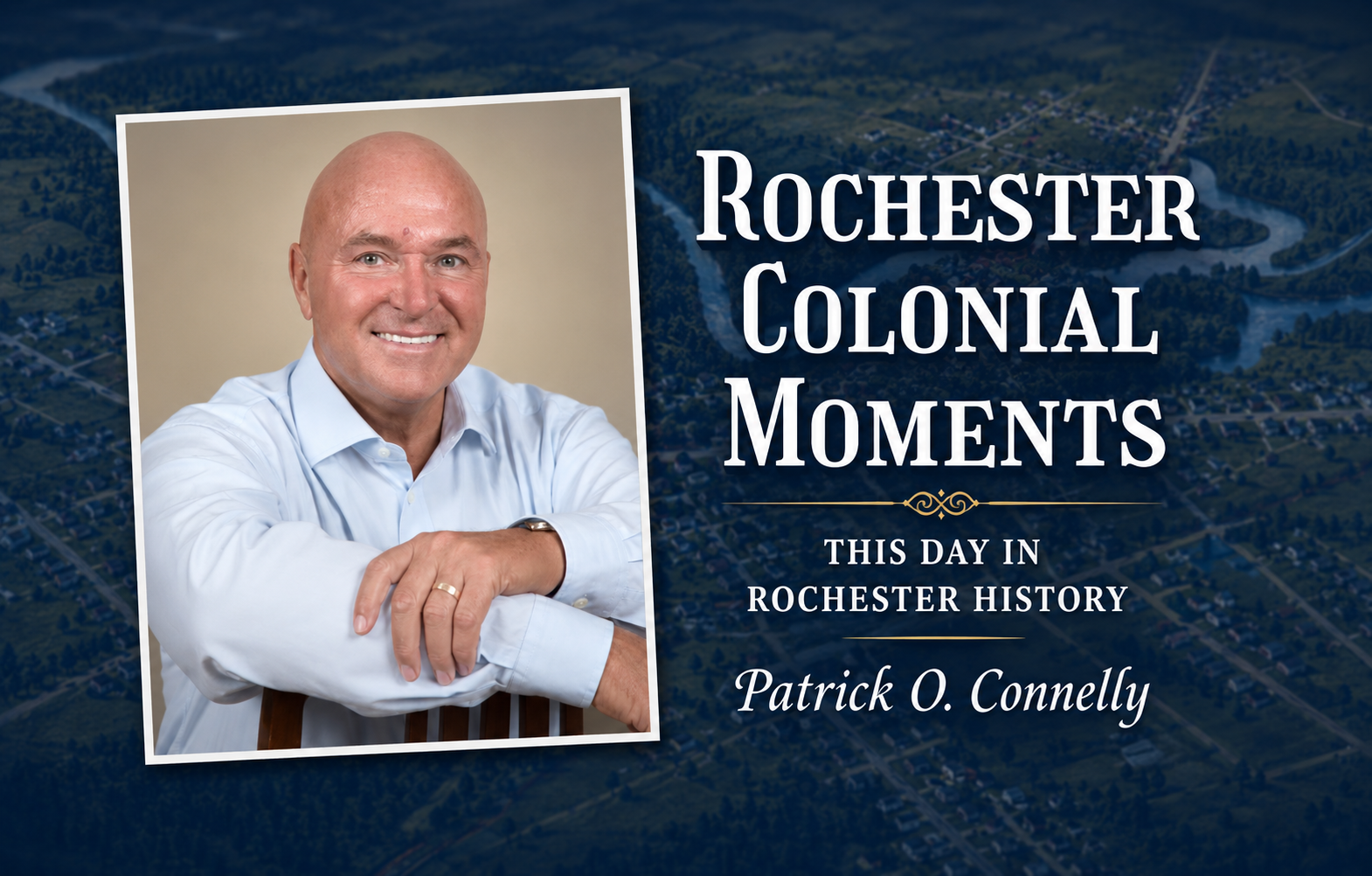
In celebration of the 250th Anniversary of the Signing of the Declaration of Independence, and in collaboration with the Office of Mayor Chuck Grassie, Rochester Colonial Moments, a historical series highlighting notable moments from Rochester’s past, is brought to you by Patrick O. Connelly, Rochester, New Hampshire, historian.
Monday, July 13, 2026
“The second division of chartered land totaled 30,000 acres and granted each proprietor 240 acres, 60 rods wide by 160 rods long, consisting mostly of timbered land. The draw was executed in December 1727 at a cost of £3 per full share. At the time, £3 would have equaled $15.00. The comparable purchasing power of that amount in current terms would be approximately $1,000.
According to the New Hampshire Census of 1732, Rochester recorded 88 polls, representing an estimated total population of 440. That population would more than double to 984 in 1767, measured just after the end of the French and Indian Wars in 1763, and would further increase to 1,553 in 1775. According to the First National Census in 1790, Rochester held a total population of 2,852 souls.
From the very beginning, the territory of Rochester was recognized as a valuable and opportune location, serving as a critical masting and timber venue, a communication and transportation gateway to the north, and an important source of farm produce for the region. These opportunities persist today.”
Patrick O. Connelly is a historian, researcher, and author whose work focuses extensively on the colonial history and development of Rochester, New Hampshire. A graduate of the University of Texas at Austin with degrees in History and French, Connelly has spent decades researching Rochester’s earliest records, maps, land divisions, and settlement history.
Connelly is the author of two comprehensive works on Rochester’s colonial history: Rochester, New Hampshire: Territory to Township, 1620–1799 and In Their Own Words: Transcription and Research of the Original Records of Colonial Rochester, New Hampshire, 1722–1799. Both books are available through his website at RNHCC.com.